Stories by Eguono Odjegba
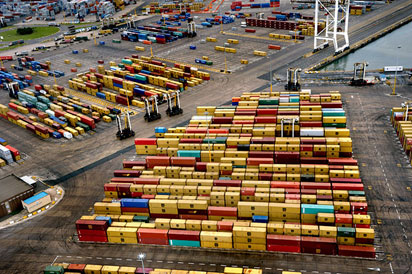
MARITIME stakeholders have blamed selfish politicking and non utilization of existing bonded terminals as cause of port congestion contrary to public perception that loss of control of trucks along the port roads and the evident gridlock as major factor militating against port operation.
This is even as stakeholders have warned that the ports roads traffic situation will remain unless the federal, state and local governments muster the political will to insist on the removal of the artificial bottlenecks that has for more than six years rendered the ports roads impassable, slowed down ports operations and by extension held the national economy to ransom.
READ ALSO:Cooking gas marketers raise alarm over 75% price hike(Opens in a new browser tab)
Mr. Muruf Raheem, a frontline ship agent and freight forwarder traced the genesis of the problem to the 2006 ports concession, an arrangement he said was bereft of professionalism, competence and ethical value and contractual and operational gaps.
He said, “One of the things those who crafted the port concession agreement failed to do was to spell out the clear position of designated bonded warehouse. If that was done I don’t see any reasons foreign terminal operators will refuse to transfer containers there. If seaport terminals are transferring containers to these bonded terminals, we will not be having the traffic situation confronting us, the traffic is artificial, the problems are from inside.
“What you see today is that the seaport terminals are holding onto containers stacked four/five boxes high, these terminals have become storage ground, while the bonded terminals built to receive these containers are all empty. Terminals are supposed to be cargo transit points, not storage facilities. So if seaport terminals are holding more than a thousand containers at any particular point in time, somebody should be held responsible, and that person should be the one saddled with the duty of ensuring that containers are regularly allocated to private bonded warehouses. Once that is done, the problems we are having will disappear.”
Collaborating, a logistics operator and Managing Director, NEDU LOGISTICS SOLUTIONS LTD, Nura Wagani attributed the problems to self serving politics, noting that the bonded warehouses may have been deliberately rendered dysfunctional to provide cover for illegal concentration of containers at seaport terminals.
His words, “It is not the ports access roads; it is the number of sitting containers at the terminals. Terminals are now storage facilities, holding thousands of containers, because of the huge patronage it enjoys from all the major shipping lines; this has created unnecessary capacity challenge.
“The port access roads will never go away because as empty containers are coming in, cargo containers too are coming in, all into the port, while the liners have only one or two berthing spaces to keep all these boxes. The volume of containers coming in is higher than the volume of containers going out. So the port road gridlock isn’t the problem.
“If all the bonded terminals are working and doing an average of 50 trucks per day, the pressure on the Lagos ports roads will reduce. Our problem is not the access roads, our problems are mother seaports terminals transforming into storage facility. Boxes are not transferred to registered bonded terminals, there are more than ten bonded terminals in Lagos alone but they are all empty. In fact their owners are in trouble, some of them borrowed money from banks to set up, to buy cargo handling equipments and to construct their facilities.
“Let us not miss the point, the Lagos ports are not deficient in actual capacity, our problem is lack of political will to do what is right. NPA should insist that contracts terms be respected; port terminals should not be allowed to run container storage, abandoned containers should speedily be identified and taken to government warehouses. Now even government warehouses have all disappeared at the ports. NPA have the duty to ensure bonded terminals assume their role in the cargo clearance value chain.”
Also speaking, Mr. Lucky Okechukwu a maritime player based in Lagos said, “Illegal fund mobilization and profiteering are part of the problem we are having. There are operators who want to maximize rent, so they hold on to containers as a mean of making money. Importers pay demurrage on containers every day, including empty containers.
“If you return your empty container early, you ask for container deposit refund, so the owners of the containers either don’t have space for you, or you spend three weeks between Mile 2 and the terminal and forfeit the deposit. Then you have political situations, where the landlord is afraid of the tenant. These are the real issues, not the port roads. When the roads are completed the issues will remain.”
President of the Merchant Seafarers Association of Nigeria, MESAN, Navy Capt. Abel Ogah, Retired, who dropped this hint recently during the celebration of Nigerian Seafarers at the Lagoon Restaurant Lagos, tagged Sailors’ Night, said until and unless government intensifies effort to rebuild its national carrier and set in motion mechanism to absorb and will engage idle professional marines and seafarers, piracy and related sea borne criminalities may remain the order of the day.
Capt Ogah said occupational and professional theft and sabotage are not possible without professionals and insiders’ participation, and stakeholders including the federal government to develop a blueprint to ameliorate the suboptimal condition under which seafarers operate, in addition to reducing the scale of joblessness in the seafaring industry.
MESAN Secretary, Capt. Alfred Oluwasegun Oniye said The Sailors’ Night was not just about feeling good, drinking and back slapping, but also a mean exploring the intellectual content of seafaring with a lecture titled Revamping Nigerian Economy through the Maritime Industry.
According to Capt. Ogah, piracy attacks has a weakening effect on the national economy and at strategies deployed towards reinventing the maritime industry as a critical element in the overall revival efforts.
He also bemoaned the state of the Nigerian maritime industry which he says has not shown sufficient performance in global maritime trade rating due to lack of national shipping over the past three decades.
He said, “Am talking about Nigerian own vessels, the advantages of these vessels is that they will not only carry out shipping businesses but the ships will also provide jobs for our seafarers and help to fix the unemployment ratio. Unfortunately we don’t have merchant fleet. So our seafarers are in the hands of private ship owners.
“In other to give credence to the merchant navy, the Nigerian Merchant Navy Act 2007 was enacted. Sequel to this, various departments and agencies have been created under the ministry of transport. In terms of infrastructure, in terms of organization, in terms of facilities, we are in place, but are we really doing well. Are we operating global best practices? Our national merchant fleet has no single craft left, except private shipping companies operating under controversial circumstances. And that is the challenge of seafarers today, if you shout, they will just throw you out and bring another person. The seafarers in Nigeria have become victims of neglect, of maltreatment by private ship owners.
“If you don’t take what they offer, you and your family will go hungry. So they settle for meagre wage out of frustration. Unemployment in Nigeria has led to unspeakable illegal activities in the maritime industry. When someone is trained on a particular profession and he is not legitimately engaged or employed, the likely thing is for him to find an alternative to survive. That is why, the militants, pirates, sea robbers are people who have been trained on the act of managing sea resources.
“What you cannot do you cannot steal. You can’t say I stole your cow when I don’t know how to herd cow. So it is only the man that understands the element and the environment that can go there and steal. That is why we have piracy.”
The post Stakeholders bemoan non-utilization of bonded terminals appeared first on Vanguard News.
by Urowayino Jeremiah via Vanguard News https://ift.tt/2SF9dkl Best Known Member of the Cabinet Wikipedia
Comments
Post a Comment